Background
The rains are coming down hard again, and Accra’s perennial flooding issue has come into sharp focus once more. Politicians/public officers have resumed work with demolition exercises, and citizens in flood prone areas are up for great distress. Hydrological - hydraulic experts have emerged from their “moribund-ness” to pontificate and talk big. Radio waves have become saturated with “flood” discussions, likewise television stations and print media. Accra is a city at war with itself. Few hours of rain reveal the deep-seated spatial weakness and defects of what is supposed to be Ghana’s CAPITAL CITY.
The flooding issue has again ignited a lot of passion and noise. As per tradition, it is expected that all will go to slumber again once the rainy season is over; the flooding issues will quickly be forgotten. Politicians and public officers who have resorted to auditing the structural integrity of buildings as well as the demolition of buildings in water path, are sure to abandon these exercises once the rainy season is over.
The flooding issue in Accra is illustrative of poor leadership and symptomatic of a people who do not learn. This essay largely reflects on urban planning with greater focus on sanitation, flooding, and public transportation issues in Accra/(Greater Accra Metropolitan Area).
Accra: A Brief History
Around the 16th Century, Accra was essentially a fishing community, and by the 19th Century, it had become a trading post until 1877 thereabout when it became an urban settlement when the colonial administration relocated the capital city to Accra from Cape Coast.[1] Merchandise trade, political, as well as economic power became heavily concentrated in Accra.
Figure 1: A Map of Accra and other Districts of Greater Accra
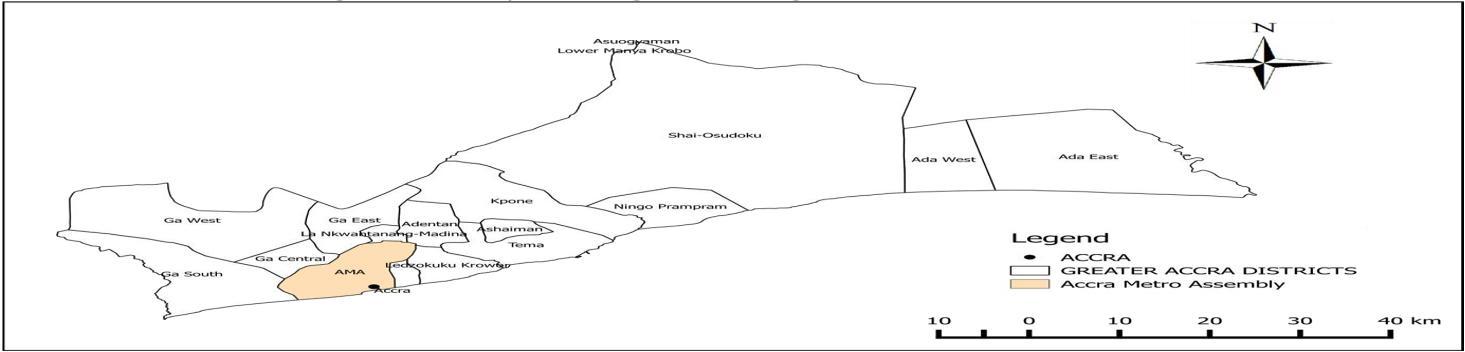
Source: AMA (2020)
After independence, Accra continued to evolve nicely and rapidly. Tema, a separate but contiguous settlement to Accra, evolved, perhaps, as Ghana’s first planned and modernised settlement. For Accra, “The period between 1960 and 1970 saw rapid industrialisation and expansion in Accra's manufacturing and commercial sectors”[2] Hereafter, partly lies the rural-urban migration problem that has thrown Accra off-balance ever since.
Accra has since become a centre of vibrant economic activity, and migration has become an evolutionary part of the city’s existence. Folks in the rural areas perceive Accra to be where dreams are realised. Migration is not a completely negative phenomenon. It is now up to city authorities to embrace migration of rural folks to Accra, and to appreciate that the migrants can be a source of capital and labour to further develop Accra; they can also represent a critical consumer base thereby stimulating business and economic activity in Accra and its immediate environs.
Accra in Numbers
The Accra Metropolis, with its three sub-metros, is a heavily urbanised settlement whose rate or degree of urbanisation has not been commensurate with proper planning. As such, a lag has been created such that infrastructure and systems in Accra have come to be inadequate to sustain life in the city.
Figure 2: Type of Administrative Areas Figure
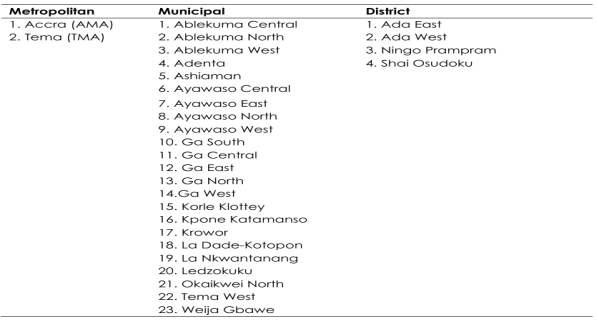
Source: GSS (2024)
3: Population Size of the in the Accra Region Greater Accra Region, 1960 - 2050
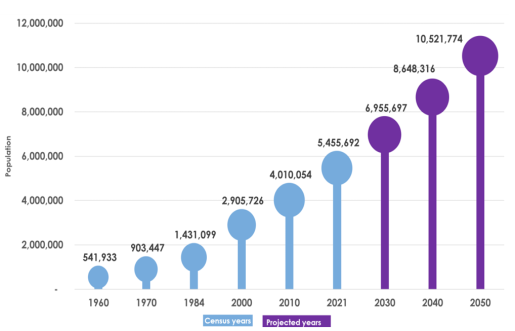
Source: GSS (2024)
Whilst planning is poor and problematic, Accra’s growing population aggravates an already messy and dicey situation. Accra’s population dynamics are primarily a function of fertility, mortality, and migration. Migration should be the lead culprit. Folks in the relatively less developed parts of Ghana perceive the grass to be so green in Accra. But the contention re ally is whether Accra is a place where money is spent or whether it is a place where money is made, considering the cost of rent, transportation, food, and general other services in the capital city. But it is worth reiterating that these migrants could be a potential source of capital and labour to further develop Accra. In other words, the migrants can become a net - benefit critical resource if they are harnessed properly.
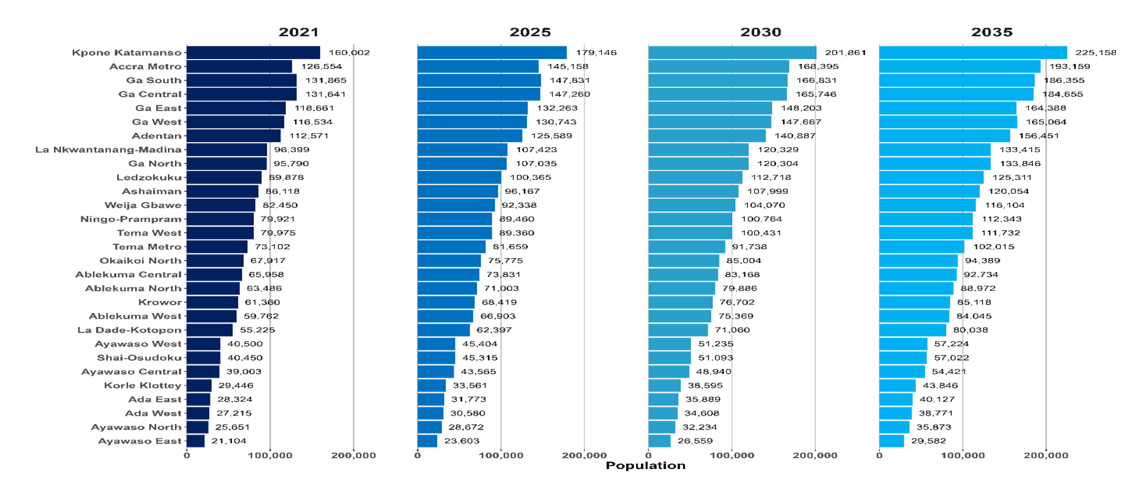
Fig 4: A Projection of the Youth Population 15 - 35 Years by District, 2021 - 2035
GSS (2024)
In accessing the overall population growth in the Greater Accra Region, AMA is projected to experience the highest youth population growth of 52.6% between 2021 and 2035, (reference figure 4).
What this means is quite straight forward. More and detailed planning is required for Accra to meet the needs and demand of th e youth/(population) bulge. This population bulge, together with the rural-urban migration phenomenon, should be the clearest indication of what is to become of Accra in about a decade time, considering the current mess the city finds itself in.
Accra Metropolitan Assembly’s Development Policy
Accra requires a steady source of funding to sustain its status as a capital city, yet “Revenue mobilised by the city, together with resources from central government and development partners are woefully inadequate to bridge the resource gap...”[3] Over the years, politicians have talked about modernisation of Accra, and declarations made of Accra becoming the “cleanest city in Africa.” The funding bit which is the biggest and most daunting challenge of all is yet to be tackled.[4] But politicians would not also stop making phantom promises that cannot be fulfilled until the basics are tackled.
Whilst funding is one of the key challenges, an appropriate and resilient urban policy for Accra is the next big challenge. Think of rosy promises such as the Bus Rapid Transit (BRT) system project. BRT failed miserably; likewise, the Sanglemi Housing and the Kasoa Hope City projects. Hence, Katanomics. Katanomics, which is illustrative of “a systemic condition in which the links between and among political promises, policy design, legal enforcement, and constitutional learning are broken or disjointed.”[5] The examples cited above are some of the most classic examples of Katanomics.
All these above-mentioned projects failed to materialise to transform Accra because too often the theatrics of politics supersedes and controls the intricate and detailed and data-driven mechanics required for policy execution success. The success rate of policy execution is not so much about political good - will or the fanfare and feel - good syndrome that so often attend these phantom dreams and political promises, but is dependent on data, detailed analysis, accountability, and national learning, and perfectly piecing together the discrete parts of a project or program or policy to make for a coherent discourse. Hence Katanomics convincingly stipulates the need for a critical policy audience capable of constant analytical scrutin y of government policies and forcing national learning and thereby insulating policy formulation and execution from the volatilities of politics.
From these very humble beginnings, we are learning from this preliminary and cursory analysis of how policy execution failures can create a total mess of even the planning and structuring of a city.
Accra’s perennial flooding, for instance, is a classic case of how much of political stamina drives critical national issues in Ghana with policy stamina relegated mostly to the background. Talk of waste management as well. The following service providers are mostly responsible for keeping Accra clean—for each of the three sub-metros that make-up Accra:
| Sub-metro | Service Provider (s) |
|---|---|
| Ablekuma South | Kobby Waste, Zoomlion Ghana Limited |
| Ashiedu Keteke | Meskworld Co L td. |
| Okai Koi South | Asadu, J. Stanley Owusu & Co. Limited |
To understand why Accra never gets clean, the Waste Management Department of the Accra Metropolitan Assembly in its December 2023 Q4 Performance Report on Solid Waste Management[6] states these key facts:
- that service providers do not even bother to submit the monthly reports of their operations as demanded by the Franchise Agreement between them and the AMA.
- that a sizeable number of households in their zones of operations were not registered thereby forcing those households to go the path of indiscriminate waste disposals.
- that the service providers are not innovative in the business of waste management.
Little wonder that enclaves such as Zongo Lane, Sepei, Kojo Ababio Street, Mantse Agbonaa, Cadbury, London Market drain, Kaneshie No.1 & 2, Avenor, Neoplan Station, Mamprobi, Korle–Gonno, and the contiguous Korle enclaves, are mostly draped in utter filth and alarming levels of pollution. The Fourth Estate has more and more to say on the sanitation problem.
Based on the foregoing, it is not difficult to also understand why informal settlements will continue to grow rapidly in Accra, with a broken public transport system, with recurring flooding, and grave sanitation problems. These problems exist because policy resilience is lacking. Policy resilience is the ultimate solution to all these. AMA’s development policy must therefore have as its foundation, policy resilience.
Accra Resilience Strategy (ARS)
For Master Plans, shiny development strategies, copious policy documents, Ghana never lacks on these. They exist in abundance. Few people would even know that a little over a decade ago, in 2014, Accra signed-up to the 100 Resilient Cities project pioneered by the Rockefeller Foundation, and that a fanciful position of Chief Resilience Officer (CRO) was created “to lead city-wide resilience building efforts” But of course, due to the absence of critical policy audience in Ghana, no one ever heard anything of the Chief Resilience Officer and of his or her whereabout, and what exact impactful work he or she did for Accra. It is certainly lost on many that, as part of this resilience project, sometime between February to December 2018, a team from AMA inclusive of which was its Head of Transport was in Singapore for a workshop “to focus on strengthening the city’s Trotro upgrading initiative.” Eight years on, Accra’s public transport (Trotro) system has grown even worse-off. Zero national learning! Zero accountability! No one has been called, and will ever be called, to answer to why the Trotro upgrading initiative failed.
A resilience strategy for Accra should also be a function of policy resilience. Take the issue of flooding in Accra/GAMA for instance. Of all the eighteen basins in the Greater Accra Region, the “Odaw River Basin contains the highest flood hazard and flood risk, especially the low-lying, central business area downstream of Caprice... ”[7] Hence, the June 3, 2015, disaster. The reappears to be no resilient national policy to address the Odaw and general flooding issue.
The Odaw problem—both the sanitation and flooding bit—continues to haunt Accra because political stamina drives that issue instead of thoughtful policy. The Odaw River is usually hurriedly desilted in anticipation of the rainy days, and afterwards, everyone goes back to sleep, because the approach to managing the city is hinged on political stamina and less on policy stamina. What really is the clear-cut detailed “current” development plan and policy for Accra? What are the detailed funding sources for such a plan or policy? What is the timeliness for what specific projects? These are the teething questions. We are only treated to repeated slogans and political promises, a situation akin to repainting a crumbling edifice and calling it a new building.
Urban planning in Accra thus lingers on a very delicate balance. Meanwhile the Ghana Statistical Service estimates the proportion of Ghana’s urban population to increase from 56.7 % in 2021 to 60.7 % in 2030 and 66.2 % in 2050.[8] What are the concrete plans in place to accommodate this population spike in Ghana’s urban areas? What becomes of the dream to elevate the Zongo’s to centres of commerce and industry[9]? The answer is that Accra has no such concrete plans.
Accra’s Broken Public/ (Mass) Transit System
Public transport (intra-city transport) in Accra is effectively dead. Public policy could not sustain the operations of Metro Mass Transit, Ayalolo, and the Bus Rapid Transit System. Should Accra get the mass transit system right, it should serve as a model to influence the entire mass transit system in Ghana.
Accra, and indeed Ghana, thoroughly lacks all the features of a functional modern transport system. But in all of this, the group(s) that have done the greatest disservice to this country are the public transport unions. These transport unions always appear in force when it comes to the issue of increasing transport fares. They are seldom heard discussing sensitive matters like plans of re-tooling the fleet of Trotro vehicles with protective wares such as seatbelts to protect passengers.
How impressive it would have been for Ghana, if GPRTU or PROTOA had a detailed annual business plan covering a period of say five years, a plan that lays out schematically and thoughtfully, proposals of how to re-tool its fleet of vehicles and have them fitted with the relevant safety wares, plans of how to modernise transport stations to better serve its clients, among others. No such plan from GPRTU or PROTOA and the likes!
These Unions are mostly dormant when they are needed the most. They are good at issuing press releases and communiqués when it comes to issues that directly affect their pockets. Where are these associations and unions when their members resort to predatory pricing at peak demand periods? Who is to carter for the concerns of commuters? They are very good at lobbying for concessions from government, but they have no regard for ensuring the safety of commuters. If they do, they will not sit unconcerned as some members of their associations operate without drivers license or ply vehicles whose key functional parts such as speedometers are not even functioning. The sad part of it all is to have the Government sit aloof at this apparent road safety crisis.
It is a sobering experience, to witness workers in Accra struggle so tirelessly to access a vehicle to and back from work, work that barely guarantees them any meaningful financial freedom. Workers in Accra face utter punishment accessing Trotro services at peak periods. Yet a Ministry of Transport exists in Ghana. The public transit system in Accra is a stark reflection of a reactive political leadership in Ghana, and an effectively dead urban planning policy.
The Transport Ministry would flatter itself about the procurement of new buses to augment public transport fleet. Such talk has been heard over and over again, yet the mass transit system breaks down completely at the least instance. To even think of the solution to the intra-city mass transit problem as merely about procuring new buses into the system, is a rather naive framing of the public policy issue at stake and marks the beginning of the failure of government’s intervention(s).
Additional fleet of vehicles on the roads, without a commensurate radical expansion in road infrastructure and multiple access routes, only intensifies the traffic flow problem in Accra and its environs. The problem at stake is structural, institutional, and political. The five hundred or so new buses for Mass Transit would not fix an ailing and terribly broken intra-city transit system; it will only add to supply capacity; it does not entirely fix the structural and institutional bottlenecks. The point canvassed in this essay is that the policy problem at stake is not simply a procurement issue but requires very deep and holistic and superior thinking and robust engineering plan which the transport ministry has not yet demonstrated; It is not a quick fix issue at all.
Quick fixes of the kind normally seen in Ghana’s development discourse creates a development lag which is not very visible at once but ultimately leads to a situation where in the long-run, Ghana would find itself to be “marking time” in its development trajectory. The development lag often comes about because the solutions deployed to address grave public policy issues usually address the issues just on the surface, just to satisfy the political will, and effects no meaningful material structural changes. Hence, Katanomics.
Conclusion
The literature and the data are clear and unambiguous. It is now time for concrete action to save Accra. Accra/Greater Accra Metropolitan Area (GAMA) requires a thorough-going spatial planning and the highest level of policy execution efficiency in the development and management of the city: from housing to public/mass transport and to employment, the state of living in Accra/(GAMA) is just too chaotic! The chaos is deceptively camouflaged by the serenity and opulence of the few plush locations of Cantonments, Airport Residential, East Legon and the likes. But these are symbolic of islands of opulence in a sea of poverty and chaos.
The are several urban development plans and models to follow should Accra ever require a model. Examples are the Vietnam Urban Upgrading Project later succeeded by the National Urban Upgrading Program (NUUP), the Mekong Delta Region Urban Upgrading Plan (MDR UUP), and the Scaling Up Urban Upgrading Project (SUUP). These Plans delivered upgrading of settlements such as Nam Dinh, Hai Phong, Can Tho and Ho Chi Minh City. Accra has no more excuses(s)!
Recommendations
- Waste management is a resource-intensive venture, and citizens must be adequately levied to fund this enterprise. The ten pesewas tax on each litre of fuel as Sanitation and Pollution Levy was right and must not be repurposed, as has been done, for the servicing of energy sector related expenses. The reasons and principles that animated the introduction of that levy must be religiously upheld.
- For the flooding issue, Ghana does not need any more strategy documents. There are enough of that. What is needed is accountability; it needs an audit of all donor-funded (especially World Bank funding) of flood-related projects over the last two decades with published results of how funds were misspent or diverted. Otherwise, this country will continue to throw money at failed endeavours. All donor funding for flood mitigation must seize until such an audit is done, and the areas of failure clearly identified and acted upon. As an addition, NADMO must now move from a reactionary entity to a pro-active one, working closely with the Ghana Meteorological Agency for early disaster (flood) detection
- The Transport Unions have had it rather too easy for a long time now. It is now time for the government to implement sweeping reforms and totally overhaul the current defective status-quo and also place serious responsibilities on the Unions. These reforms should be aimed at ensuring greater efficiency, accountability, and responsibility from the Transport Unions and its members.
- In connection to point three (3) above, the government should make it mandatory for the transport unions (the Trotro operators to be specific) and their members to provide an annual plan (over a period of not less than 5 years) of their operations, to be reviewed and sanctioned by the government before the beginning of each year. Such a document should lay out proposals and plans for general transport service delivery and ways to improve on same. In effect, the government must set key performance indicators for these Unions and its members aimed at totally transforming the public transport system over the next five years.
- The quality of some of the vehicles that ply the roads in Ghana as public transport vehicles clearly demonstrates that DVLA’s roadworthy regime is terribly flawed. The Ministry of Transport must task DVLA (together with MTTD and the National Road Safety Commission) to form a Joint Implementation Committee to ensure that in a space of six months, all public transport vehicles (especially Trotro’s and Taxis) that are not roadworthy should be off the roads in Accra and Ghana as a whole. The government, through the transport ministry, must take it as a profoundly serious task to protect commuters. Vehicles that are not fit to even transport contraband goods should not be used to commute human beings.
Sources Consulted
Accra Metropolitan Assembly (AMA). (2023). Performance Report on Solid Waste Management Contractors, October to December 2023. Accra: AMA.
Accra Metropolitan Assembly. (2020). 2020 Voluntary Local Review Report, On the Implementation of the 2030 Agenda for Sustainable Development and African Union Agenda 2063. AMA.
Accra Metropolitan Assembly. (2023). Monitoring and Evaluation Report: Second Quarter Progress on the Implementation of the Meduim-Term Development Plan, 2022 - 2025. AMA.
Accra Metropolitan Assembly. (2025). Accra Road Safety Report, 2024. AMA.
Ghana Statistical Services. (2024). Ghana 2021 Population and Housing Census, Population Projections, 2021 - 2050, Greater Accra Region. Accra: Ghana Statistical Service.
Simons, B. (2025). How Dangote Adapted to Katanomics in Nigeria. Accra.
The World Bank. (2020). Greater Accra Climate and Flood Risk Mitigation Strategy: Making Sound Investment Choices for Flood Protection. The World Bank.
World Bank. (2021). Guidance Note on Community Participation in Slum Upgrading. World Bank.
Zongo Development Fund. (2023). Press Briefing. Press Briefing by Dr. Arafat Sulemana Abdulai, CEO of the Zongo Development Fund. Accra: Zongo Development Fund.
References & notes
- Accra Metropolitan Assembly (202 0): Voluntary Valuation Report, page 2 ↩
- Accra Metropolitan Assembly (2020): Voluntary Valuation Report, page 2 ↩
- AMA (202 0): 2020 Voluntary Valuation Report, page ix ↩
- Ibid, page s 42 and 43 ↩
- Simons (2025): How Dangote Adapted to Katanomics in Nigeria, page 3 ↩
- Accra Metropolitan Assembly (2023): Solid Waste Management Evaluation Report, pages 9 - 13 ↩
- World Bank Group (2020): Greater Accra Climate and Flood Risk Mitigation Strategy, page XVI ↩
- GSS(2024): 2021 Population and Housing Census; Population Projections, 2021 - 2050, Greater Accra Region, page 14 ↩
- Zongo Development Fund (2023): Press Briefing by Dr. Arafat Sulemana Abdulai ↩
What is your reaction?
Share a quick signal with other readers.
Join the Conversation
Share your perspective with the CAPPAD community.
View 0 Comments